Sunday, August 30, 2015

From a Newsboy to a Writer

Newsboy
Credit: collectorsbicyles.com
“‘Buddy,’ she said, ‘maybe you could be a writer.’ I clasped the idea to my heart. I had never met a writer, had shown no previous urge to write, and hadn’t a notion how to become a writer, but I loved stories and thought that making up stories must surely be almost as much fun as reading them. Best of all, though, and what really gladdened my heart, was the ease of the writer’s life. Writers did not have to trudge through the town peddling from canvas bags, defending themselves against angry dogs, being rejected by surly strangers. Writers did not have to ring doorbells. So far as I could make out, what writers did couldn’t even be classified as work. I was enchanted. Writers didn’t have to have any gumption at all. I did not dare tell anybody for fear of being laughed at in the school yard, but secretly I decided that what I’d like to be when I grew up was a writer.” (pg. 26)

Writing
Credit: Drew Coffman flickr.com
The passage I chose was, I thought, important to the book. It shows Mr. Baker’s realization that he could be a writer. It doesn’t require the “gumption” any of the other jobs, like selling papers, his mother throws at him, require. The passage shows his first real interest in the profession he would later take up. As important as I feel it is to the memoir, I also think it’s beautifully written, and I’m only saying that because I don’t know what else to say. Let me explain it as this: Mr. Baker writes and it really feels like real life, which it is (the book being about his life an all). So, I guess this is me relating to the book because I know what it feels like. I know what it feels like to not have gumption, or initiative, to want to go out and find a “real job”. I want to be a writer, so I know what it feels like to not want to tell people because you feel like you’ll be laughed at or told, “That’s not a real job.” I know what it’s like. And I don’t think I’ve ever found truer words that those in this passage. Basically, what I’m trying to say is that this passage really means a lot to me.

Tuesday, August 25, 2015

Suspiciously like my Thoughts

Suspiciously like Real Life” from the New York Times, the editorial review I chose, was written in 1982 by Richard Lingeman. Lingeman states that going into read Growing Up, he thought that it was one of those “books one can put down with a content sign” and feel bad for the person. I didn’t have
Richard Lingeman
Credit: Anthea Lingeman 
this feeling going into the book. I believe this is because, prior to reading the book off the list we were given, I had never heard of Mr. Baker. However, I do agree with Lingeman, now having read Growing Up. What is represented in Growing Up is not something you put down and say, “Oh, you have it worse than me.” It’s something you can laugh and cry with and relate to because, as Lingeman put it ever so simply, it “bares a suspicious resemblance to real life.” Even in bad times, we can learn that “well,” to quote Olaf the Danish salesman, Mr. Baker’s mother’s former boyfriend, “it will all come out O.K," something will turn up. Lingeman goes on to say that “that is more or less the moral of Growing Up.” That something will turn up.

Thursday, July 30, 2015

Growing Up: A Summary of the Memoir by Me, the Reader

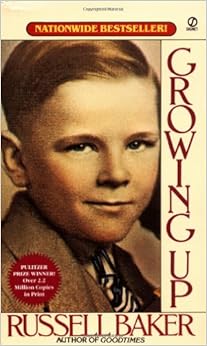
The cover of Growing Up
Growing Up starts in the present (well, less presently now), with Baker’s mother and her fading memory. It then goes back in time to his mother raising him from the age of five as a single parent, his father having died. Baker’s mother was a big influence on his life. Being a school teacher herself, she taught him to read and write. He was praised in school for his writing, which earned him a spot at City College, a fancy high school in Baltimore, and later a scholarship to Johns Hopkins University. This period of time happened during the Great Depression. Baker, his sister, and their mother moved their place of residents multiple times. Through their various moves, they lived with a myriad of relatives, from whom, Baker learned sundry life lessons. As Baker goes on to university, World War II is erupting in Europe. Eager to join the fight, he joined the Navy to become a pilot, which he’d always dreamed of doing. After the war ends, never having seen the battle, Baker returns to Johns Hopkins. He meets girl named Mimi while out with a friend one night. After he works his way up the totem pole at the Baltimore Sun newspaper, they get married. The book ends in the present, where it started, with Baker going to see his mother, who is in the hospital.

Sunday, June 28, 2015

Ladies and Gentlemen, Russell Baker!

Time Cover from June 4th, 1979
Pulitzer Prize winning author, Russell Wayne Baker, was born on August 14, 1925, in Morrisonville, Virginia. After his father died, when he was five, Baker, one of his sisters, and their mother moved around. They, finally, laid roots in Baltimore, Maryland. He went to college at Johns Hopkins University in Baltimore, where he graduated in 1947, after serving in the U.S. Navy during World War II, with a degree in English literature. After graduating, he got a job at the Baltimore Sun as a journalist. Baker, then, went on to work for the New York Times, covering things that went on within the government and in the White House.

Throughout the follow years, Baker publish several books; starting with Growing Up published in 1982. Growing Up is about Baker’s childhood, specifically how he grew up during the Great Depression. It has a sequel titled, The Good Times, published in 1989, in which he talks about his time as a journalist.